

Oneirix is heading to NeurIPS in Paris. We’re sharing the preprint behind our research into a deceptively simple question: is the end of a model’s computation always the right place to read its answer?
Some AI systems make predictions by repeatedly updating an internal state, then reading the final one. Our paper identifies controlled cases where further computation damages that final prediction while earlier states still contain information that supports accurate prediction. We call this a pre collapse regime, a period in which the model’s endpoint has deteriorated but a useful part of its earlier trajectory remains.
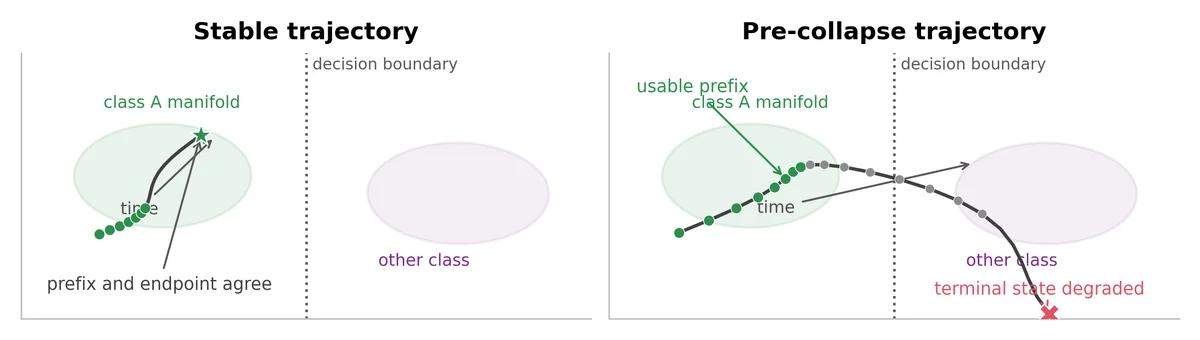
Timing and training both matter.
The paper compares reading an early window of states, stopping adaptively, and GRACE, Growth Regulated Adaptive State Extraction, which reduces the contribution of states showing excessive growth. Which approach works best depends on the system’s dynamics. In some of the trained models, a simple early window is stronger than the more elaborate decoder.
In the Tiny ImageNet experiments using frozen visual features, running models trained for eight steps out to 32 steps reduced final prediction accuracy by 5.11 percentage points for the recursive SwiGLU model and 2.42 percentage points for the shared attention model. Earlier states remained predictive. Matched longer training configurations removed that deterioration in both tested architectures, showing why the conditions used during training and the time at which an answer is read need to be evaluated together.
These are controlled experiments, with three seeds per condition in the modern recursive model comparison. They establish a failure mode in the systems and conditions studied, rather than its prevalence across deployed AI. They also show why evaluating only the final output can miss useful information about how a model behaves during computation.
Terminal Failure Is Not Computational Failure: A Pre-Collapse Readout Regime in Nonlinear Dynamical Learners
Rohan Maskrey Research preprint 38 pages
The full paper includes the experimental methods, results, limitations and supporting analyses.